
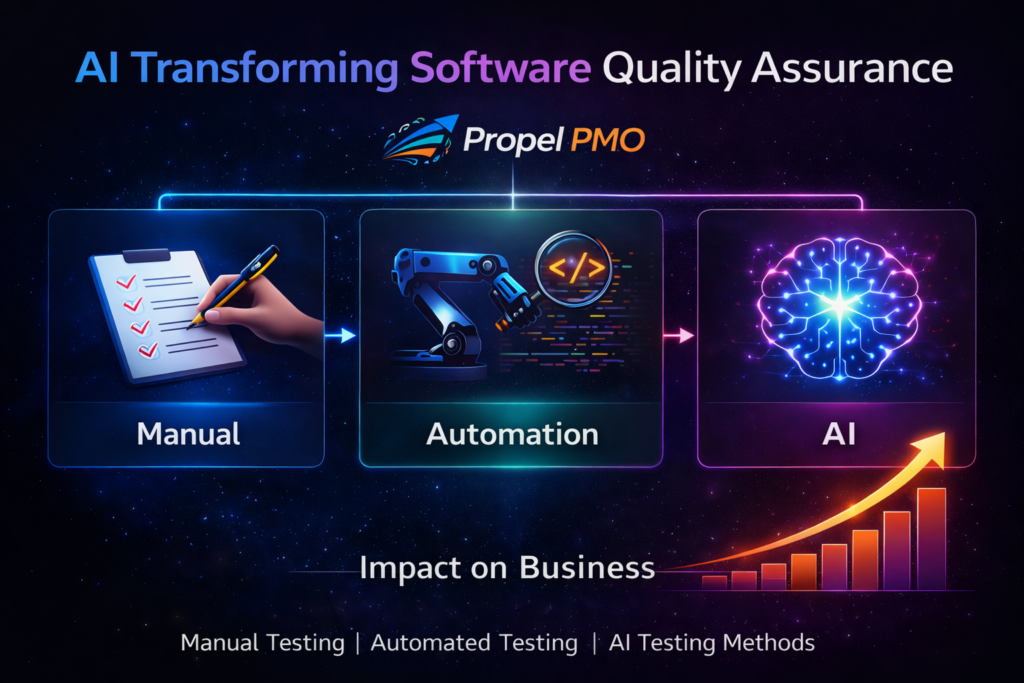
Discover how AI is transforming Software Quality Assurance. Learn the difference between manual, automation, and AI testing, plus practical AI testing methods that drive measurable business impact.
Software Quality Assurance Is No Longer Just About Finding Bugs
Software Quality Assurance (SQA) has evolved from a validation checkpoint to a strategic business function. In modern digital ecosystems—cloud-native platforms, APIs, microservices, AI-enabled products, and continuous deployment pipelines—quality is directly tied to revenue, customer trust, regulatory compliance, and brand reputation.
Organizations that treat QA as a technical afterthought face higher defect leakage, delayed releases, and increased operational risk.
At Propel PMO, we believe quality engineering must be intelligent, predictive, and aligned with business objectives—not just technical validation.
Manual vs Automation vs AI Testing: Understanding the Strategic Difference
Before exploring AI-driven methods, it is essential to understand how manual, automation, and AI testing differ in capability and impact.
1️⃣ Manual Testing: Human Judgment and Exploratory Insight
Manual testing relies on QA professionals to execute test scenarios without automation scripts.
Where It Adds Value
- Exploratory testing
- Usability and UX validation
- Complex business rule interpretation
- Edge-case discovery
Strengths
- Human intuition and empathy
- Contextual decision-making
- Ability to detect visual and usability flaws
Limitations
- Time-intensive
- Not scalable
- Difficult to maintain consistency across releases
Manual testing remains essential for validating real-world user experience and business workflows.
2️⃣ Automation Testing: Speed and Repeatability
Automation testing uses scripts and frameworks to execute predefined test cases automatically.
Where It Adds Value
- Regression testing
- Smoke testing
- CI/CD pipelines
- API validation
- Performance baselines
Strengths
- Faster feedback cycles
- High repeatability
- Scalable execution
Limitations
- Script maintenance overhead
- Fragility when UI changes
- Limited ability to adapt dynamically
Automation is now a foundational capability. However, it remains rule-based and reactive.
3️⃣ AI Testing: Intelligence and Predictive Quality Engineering
AI testing integrates machine learning, data analytics, and intelligent automation to enhance decision-making within QA processes.
Instead of simply executing tests, AI systems analyze patterns, predict risks, adapt to change, and optimize execution strategies.
AI testing does not replace manual or automation testing—it enhances and orchestrates them.
AI Testing Methods QA Teams Should Master
Below are the most practical and high-impact AI testing methods, including realistic examples and measurable business outcomes.
1️⃣ AI-Driven Test Case Generation
What It Does
AI analyzes user stories, acceptance criteria, API documentation, and historical defects to automatically generate comprehensive test cases.
Example
A banking platform launches a new “Buy Now, Pay Later” feature. Instead of manually drafting dozens of test scenarios, AI:
- Identifies credit score boundary conditions
- Generates negative validation tests
- Creates concurrency scenarios for multiple loan requests
- Suggests fraud detection edge cases
- Builds data variations for income thresholds
QA professionals then review and refine the output rather than starting from scratch.
Business Impact
- Reduces test design time by up to 40–60%
- Increases coverage consistency
- Minimizes missed edge cases
- Accelerates release readiness
2️⃣ Intelligent Risk-Based Test Prioritization
What It Does
AI analyzes code commits, module dependencies, historical failures, and production defect data to prioritize high-risk test cases.
Example
A retail e-commerce company updates its pricing engine. AI evaluates:
- Recent changes in discount logic
- Historical defect density in pricing modules
- Integration dependencies with checkout and tax calculation
It then assigns a risk score and executes high-impact regression tests first.
Business Impact
- Faster CI/CD feedback
- Reduced infrastructure cost
- Earlier detection of revenue-impacting defects
- Optimized test execution time
3️⃣ Self-Healing Test Automation
What It Does
When UI elements change, AI detects structural and visual similarities to update test scripts automatically.
Example
A login button’s ID changes after a UI redesign. Traditional automation fails. AI:
- Recognizes the button’s label and location
- Matches attributes based on context
- Updates selectors automatically
The test proceeds without manual script maintenance.
Business Impact
- Reduces maintenance effort
- Increases automation stability
- Minimizes false failures
- Improves CI reliability
4️⃣ AI-Powered Root Cause Analysis
What It Does
AI analyzes logs, system metrics, stack traces, and historical trends to classify failures accurately.
Example
An intermittent checkout failure occurs in staging. AI determines:
- Failures correlate with peak CPU usage
- No related code defects were introduced
- Network latency spikes occurred during execution
AI categorizes the issue as infrastructure instability, not a functional defect.
Business Impact
- Reduces mean time to resolution (MTTR)
- Prevents unnecessary defect escalation
- Improves collaboration between Dev, QA, and Infrastructure teams
- Enhances operational efficiency
5️⃣ Predictive Defect Detection
What It Does
AI models predict defect-prone areas based on code complexity, change frequency, developer activity, and prior defect history.
Example
A microservice modified repeatedly within a short timeframe receives a high defect probability score. QA increases exploratory and regression coverage in that area before release.
Business Impact
- Proactive risk mitigation
- Fewer production incidents
- Improved release confidence
- Better resource allocation
6️⃣ Visual AI Testing
What It Does
AI evaluates visual layout consistency, accessibility compliance, and UI integrity across devices.
Example
A responsive web application works correctly on desktop but causes text overlap on smaller tablet screens. AI detects layout shifts and accessibility violations even though functional tests pass.
Business Impact
- Protects brand reputation
- Ensures consistent user experience
- Reduces post-release UI defects
- Improves accessibility compliance
7️⃣ Synthetic Test Data Generation
What It Does
AI generates realistic but anonymized datasets to simulate real-world scenarios without exposing sensitive production data.
Example
A healthcare system requires rare disease test cases for validation. AI creates statistically accurate patient records while maintaining privacy compliance.
Business Impact
- Enhances compliance
- Enables rare scenario testing
- Reduces data privacy risk
- Improves coverage quality
8️⃣ Performance Anomaly Detection
What It Does
AI detects unusual performance trends even when metrics remain technically within threshold.
Example
An application response time increases gradually from 200ms to 350ms. Though still acceptable, AI flags it as a potential performance degradation trend.
Business Impact
- Early detection of scalability issues
- Prevention of production slowdowns
- Better customer experience
- Improved infrastructure planning
Strategic Implications for Organizations
In the coming decade, quality will be defined not by how many tests are executed, but by how intelligently testing is orchestrated.
Organizations that modernize QA will achieve:
- Faster release cycles
- Lower defect leakage
- Reduced operational cost
- Improved customer satisfaction
- Stronger compliance posture
Those that fail to evolve will experience escalating technical debt and competitive disadvantage.
How Propel PMO Drives Intelligent Quality Transformation
Propel PMO partners with organizations to:
- Align QA strategy with enterprise transformation initiatives
- Integrate AI-enabled testing into DevOps ecosystems
- Establish scalable governance frameworks
- Implement risk-based quality metrics
- Enable predictive, data-driven quality management
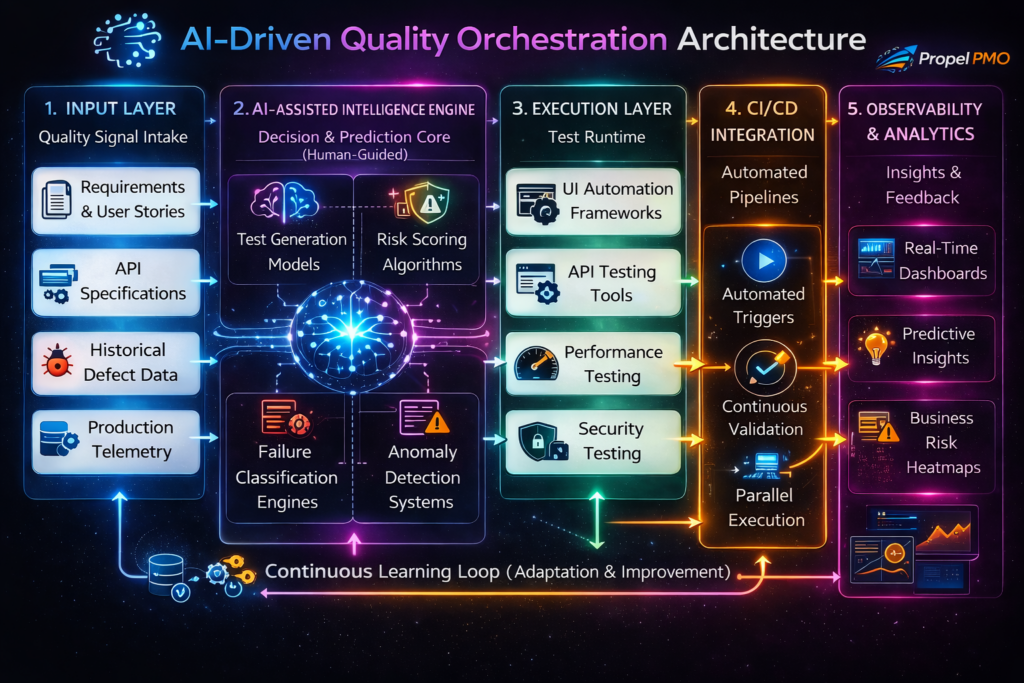
A future-ready QA architecture:
Quality is not a phase. It is a strategic capability.
Great breakdown of how QA is evolving. In many organizations, the real challenge is not adopting automation or AI tools, but changing the mindset from “testing as a phase” to “quality as a continuous engineering practice.”
AI-driven techniques like risk-based prioritization and predictive defect analysis can significantly reduce release risk when combined with strong domain knowledge from QA teams. The key is orchestration—manual insight, automation speed, and AI intelligence working together.