
Introduction
AI PMO is not a rebranding of Traditional PMO, nor is it simply adding artificial intelligence tools into existing project management frameworks. It represents a fundamental shift in what is being governed.
Traditional PMOs manage projects — defined initiatives with a beginning, middle, and end. AI PMOs manage decision-making systems — technologies that learn, adapt, and influence real-world outcomes long after deployment.
As organizations increasingly rely on AI to support hiring decisions, credit scoring, fraud detection, pricing optimization, forecasting, and customer engagement, the governance challenge expands. The question is no longer just:
- Was the system delivered on time and on budget?
The more important questions become:
- Is the system behaving as intended?
- Is it still accurate?
- Is it fair?
- Is it aligned with regulatory and ethical expectations?
- Is it delivering measurable business value?
This shift moves the PMO from delivery oversight to ongoing intelligence governance.
Planning and Requirements
Traditional PMO
Traditional PMO planning is structured around:
- Clearly defined requirements
- Early scope definition
- Fixed deliverables
- Milestone-based execution
- Success measured by on-time, on-budget delivery
Requirements are documented upfront, approved by stakeholders, and used as the baseline for execution. Once scope is locked, change management processes are triggered for modifications. This works effectively for deterministic systems where outputs are predictable and logic remains stable over time.
In this model, delivery marks completion. Once the solution is deployed, ownership transitions to operations.
AI PMO
AI initiatives require a fundamentally different planning approach.
Rather than fixed requirements, AI PMO operates using:
- Hypothesis-driven planning
- Outcome-based framing
- Iterative experimentation
- Confidence-based success metrics
Instead of asking, “What features should we build?” AI PMO asks:
- What decision are we improving?
- What business outcome are we influencing?
- What level of prediction confidence is acceptable?
- What risks are tolerable?
AI models evolve as new data becomes available. That means scope cannot be permanently locked. Planning must account for retraining, recalibration, monitoring, and adaptation.
Success is not defined solely by deployment. It is defined by sustained performance and measurable outcome improvement.
Testing and Validation
Traditional PMO
Traditional systems are validated through:
- Functional testing
- Integration testing
- User Acceptance Testing (UAT)
- Clear pass/fail criteria
The system either meets specifications or it does not. Testing confirms that requirements were implemented correctly and that the solution performs as expected.
Once testing is complete and stakeholders approve, the solution moves to production.
This approach assumes outputs are consistent and predictable.
AI PMO
AI systems produce probabilistic outputs, not deterministic results. Therefore, validation must extend beyond functionality.
AI PMO incorporates:
- Statistical evaluation of accuracy
- Precision and recall measurements
- Confidence thresholds
- Bias and fairness testing
- Explainability and interpretability reviews
The question is no longer “Does it work?”
The question becomes “How well does it work, under what conditions, and with what level of risk?”
Additionally, AI systems can degrade over time due to:
- Changes in data patterns
- Market shifts
- Behavioral changes in users
Therefore, validation is continuous, not a one-time event.
Risk Management
Traditional PMO
Traditional risk management focuses on execution risk, including:
- Schedule delays
- Budget overruns
- Scope creep
- Resource constraints
- Vendor performance
These risks are operational and largely time-bound to the project lifecycle.
Once the project is delivered successfully, risk exposure significantly decreases.
AI PMO
AI risk extends far beyond the delivery phase. It includes systemic, reputational, regulatory, and ethical dimensions.
Key AI-specific risks include:
- Data bias embedded in training datasets
- Model drift as data patterns change
- Ethical misuse or unintended consequences
- Lack of explainability in regulated industries
- Regulatory non-compliance
- Reputational damage from unfair or inaccurate decisions
AI systems can continue generating flawed outcomes long after deployment if not monitored properly.
Risk management in AI PMO is therefore ongoing and outcome-focused, not delivery-focused.
Governance Approach
Traditional PMO
Traditional governance typically includes:
- Stage gate reviews
- Steering committees
- Periodic executive reporting
- Change control boards
Governance checkpoints occur at predefined milestones. Oversight is structured around decision approvals and resource allocation.
Once deployment occurs, formal governance often reduces significantly.
AI PMO
AI PMO governance must be continuous and adaptive.
It includes:
- Ongoing performance monitoring
- Post-deployment oversight
- Model review boards
- Data governance alignment
- Ethical risk escalation frameworks
- Clear accountability for AI-driven decisions
Governance shifts from periodic approval to sustained accountability.
Executives must have visibility into:
- Performance trends
- Drift indicators
- Bias metrics
- Compliance posture
- Business impact
AI governance does not end at go-live — it intensifies after deployment.
Strategic Implications for the Enterprise
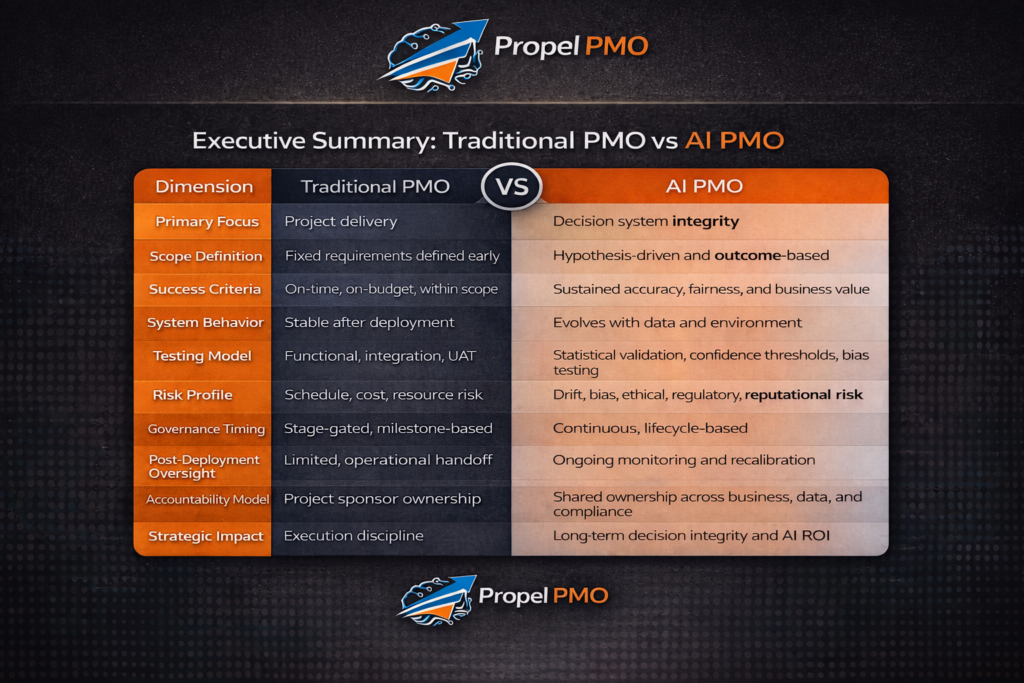
The difference between Traditional PMO and AI PMO is not procedural; it is strategic.
Traditional PMO protects delivery discipline.
AI PMO protects decision integrity.
Without AI PMO capabilities, organizations risk:
- Eroding trust in AI systems
- Regulatory exposure
- Hidden performance degradation
- Misaligned business outcomes
With AI PMO, organizations gain:
- Sustainable AI ROI
- Transparent decision systems
- Controlled innovation
- Increased executive confidence
Conclusion
Traditional PMO ensures that initiatives are delivered efficiently and predictably. It remains essential for deterministic projects and structured transformations.
AI PMO ensures that intelligent systems remain accurate, ethical, and aligned with evolving business objectives. It governs not only delivery, but behavior and long-term impact.
As AI adoption accelerates across industries, the PMO must evolve from managing projects to managing intelligence.
The organizations that recognize this shift early will be better positioned to innovate responsibly, scale AI safely, and maintain trust in an increasingly automated world.
AI PMO ensures long-term trust, safety, and value realization.
By Dhruvak Shah
With editorial support from the Propel PMO team