
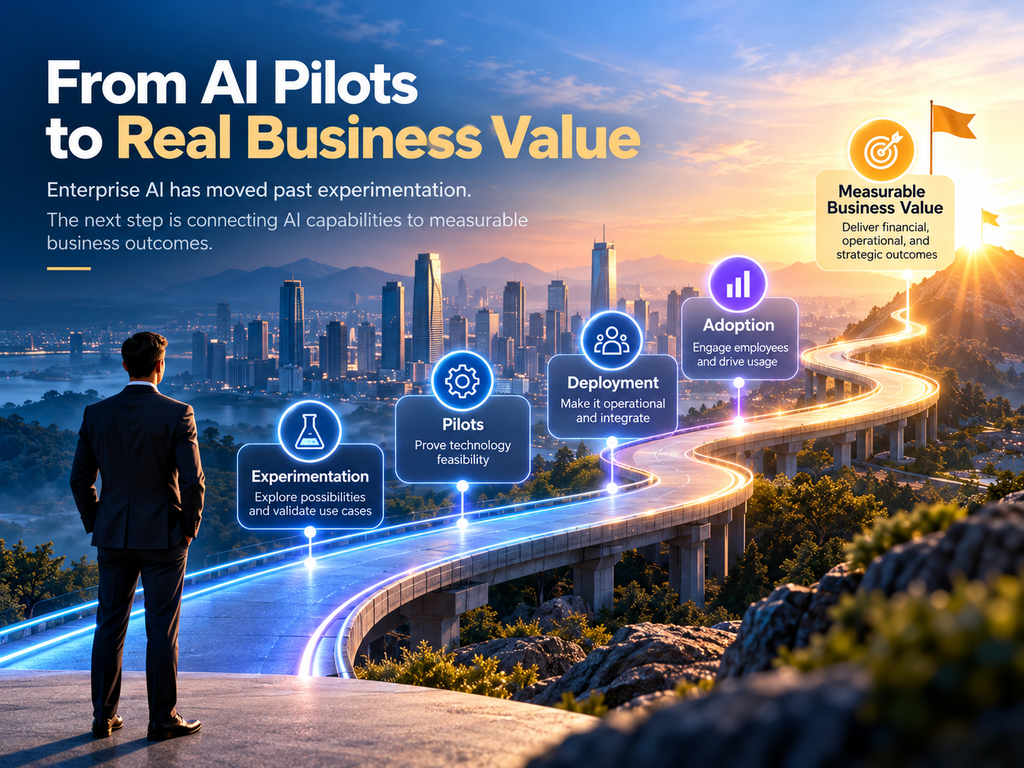
Enterprise AI has moved past experimentation. Organizations are expanding pilots into copilots, inEnterprise AI has moved past experimentation. Organizations are expanding pilots into copilots, intelligent automation, predictive analytics, and autonomous agents. Yet one question is still hard to answer: What measurable business value is AI actually delivering?
A successful demo demonstrates technical feasibility under specific conditions. A deployment confirms that a solution is operational. High adoption indicates employees are using the technology. None of these, on its own, proves a positive return on investment.
The challenge isn’t just building AI capabilities. It’s connecting them to business outcomes, measuring them credibly, and sustaining the results. That’s where the Project Management Office (PMO) can evolve from delivery assurance to AI value realization.
Why successful pilots don’t always produce financial returns
Pilots are designed to demonstrate feasibility in a controlled environment, often with curated data, a small user group, and simplified workflows.
Production is different. It introduces data engineering, security controls, integrations, training, governance reviews, and ongoing model monitoring.
A pilot that performs exceptionally well under controlled conditions may deliver more modest results when exposed to real operational constraints.
Time saved is not value realized
Imagine an AI tool that reduces monthly report preparation from eight hours to two—a 75% reduction. That’s a potential benefit. It becomes realized business value when the organization can demonstrate that those six hours contributed to avoided costs, additional productive capacity, faster decisions, or better business outcomes.
Or consider a team that saves 400 hours a month. Leadership still needs to establish whether that capacity translates into lower external spending, higher throughput, reduced overtime, or improved service delivery.
Without that connection, productivity gains remain operational indicators rather than confirmed financial benefits.
A practical measurement model separates three categories:
- Activity: 10,000 AI interactions. This indicates usage.
- Productivity: 400 hours saved monthly. This demonstrates potential capacity gains.
- Business outcome: 15% more cases completed at comparable quality. This represents measurable operational value.
The goal isn’t to dismiss adoption or productivity metrics. It’s to establish a traceable relationship between AI activity and organizational performance.
Count the full cost
AI investment costs extend well beyond software subscriptions and model usage. A comprehensive evaluation should include:
- Technology: Licensing, inference, infrastructure, and platform services.
- Integration: APIs, enterprise applications, data pipelines, and workflow changes.
- Security and governance: Access controls, evaluations, monitoring, compliance, and auditability.
- People and change: Training, process redesign, adoption support, and human oversight.
- Ongoing operations: Model updates, quality monitoring, incident management, and vendor management.
Agentic AI can introduce additional costs through repeated tool calls, exception handling, orchestration, and human review.
An initiative that appears inexpensive during a pilot can become materially more expensive when scaled across departments. That’s why enterprise AI requires a total cost of ownership (TCO) approach rather than a narrow implementation budget.
A practical framework for measuring ROI
Start with a credible baseline.
Before deployment, document existing process costs, cycle times, quality levels, error rates, and business performance. Then define measurable targets and establish how outcomes will be validated.
The basic formula is:
AI ROI (%) = (Verified Financial Benefits − Total AI Costs) ÷ Total AI Costs × 100
Consider this hypothetical annual example:
- Verified operating cost reduction: $240,000
- Avoided external service spending: $110,000
- Total financial benefits: $350,000
- Total annual AI costs: $200,000
- Net financial benefit: $150,000
- Illustrative ROI: 75%
This calculation assumes that benefits are incremental, attributable to the initiative, and not counted elsewhere.
A credible assessment should also account for implementation timing, one-time costs, uncertainty, and whether benefits will persist.
Not every benefit can be responsibly converted into dollars. Risk reduction, customer experience, and strategic capability may require separate measures rather than speculative financial valuations.
The AI Value Realization Scorecard
Traditional project dashboards emphasize schedule, budget, scope, and delivery status. AI initiatives require these measures, but they also need evidence of sustainable business value.
Propel PMO’s proposed AI Value Realization Scorecard evaluates five dimensions:
- Financial impact: Is AI producing verified economic benefits? Examples include net savings, ROI, and avoided spending.
- Operational efficiency: Are processes performing better? Examples include cycle time, throughput, and error rates.
- Adoption and utilization: Are intended users incorporating AI effectively? Examples include active usage and workflow completion.
- Risk and quality: Are outcomes reliable and controlled? Examples include exception rates, quality scores, and incidents.
- Strategic value: Does AI advance organizational priorities? Examples include customer experience and capability development.
The scorecard shouldn’t be treated as a universal weighted formula.
A customer service initiative may emphasize service quality and resolution time, while an internal finance automation project may prioritize processing costs and accuracy.
The principle is consistency: Every AI initiative needs agreed success criteria, a measurement owner, and a defined review cycle.

How the AI PMO becomes a value realization function
The AI PMO can connect investment strategy, technology delivery, operational performance, and executive decision-making across the entire AI lifecycle:
- Before investment: Validate the business case, establish baselines, identify dependencies, and define measurable outcomes.
- During delivery: Track costs, scope, readiness, adoption risks, and changes to expected benefits.
- At launch: Confirm operational ownership, quality controls, and measurement mechanisms.
- After deployment: Compare actual outcomes against baselines, validate benefits with finance and business owners, and recommend whether to scale, optimize, or discontinue the initiative.
The PMO should coordinate this accountability rather than claim sole ownership of business results. Finance, technology, risk, and operations leaders all share responsibility.
Effective AI value realization also depends on operational governance. As discussed in our earlier article, The Enterprise AI Policy Stack: Turning AI Principles Into Operational Controls, enterprise AI policies must translate into practical controls and clear accountability.
The result is a more meaningful executive conversation.
Instead of asking only, “Is the AI project on schedule?” leadership can ask:
“Is this AI investment delivering enough measurable value to justify continued funding?”
From individual projects to portfolio decisions
As enterprise AI adoption grows, measuring initiatives individually is no longer sufficient.
Departments may purchase overlapping capabilities, different teams may report the same productivity benefits, and shared infrastructure costs may be missing from project-level financial models.
A portfolio approach gives leadership a consolidated view of AI investments and a consistent way to compare initiatives.
Each initiative can be classified into one of four decisions:
- Scale: Verified value, acceptable risk, and repeatable performance.
- Optimize: Promising outcomes, but cost efficiency or adoption requires improvement.
- Reassess: Uncertain benefits, weak attribution, or material risks.
- Stop: Persistent negative economics or unacceptable risk.
This isn’t about slowing innovation. It’s about directing capital, technology resources, and organizational attention toward initiatives most likely to deliver measurable results.
A 90-day starting point
Organizations don’t need a large transformation program to begin measuring AI value more effectively.
- Days 1–30 — Establish visibility: Inventory active AI initiatives, identify investment owners, document existing costs, and select a manageable set of business KPIs.
- Days 31–60 — Validate measurement: Establish baselines, agree on benefit attribution, review total costs, and implement the AI Value Realization Scorecard.
- Days 61–90 — Act on evidence: Conduct portfolio reviews, verify early results, resolve measurement gaps, and make informed decisions to scale, optimize, reassess, or stop initiatives.
The first 90 days should establish measurement discipline, not promise full financial payback. Some AI initiatives require longer observation periods before outcomes can be assessed reliably.
The bottom line
The number of AI pilots launched, agents deployed, or employees using copilots cannot, by itself, demonstrate whether enterprise AI investments are succeeding.
The next competitive advantage will come from connecting AI capabilities to measurable financial, operational, and strategic outcomes.
Organizations that combine innovation with disciplined measurement will be better positioned to distinguish promising experiments from sustainable enterprise value.
For the modern AI PMO, the mandate is clear: Connect strategy, governance, execution, and benefits realization.
At Propel PMO, we believe successful transformation is defined not by technology adoption alone, but by the value organizations can demonstrate and sustain.
Smarter Delivery. Stronger Value.