

Most organizations already have an AI policy. The problem is that many of those policies are still written at the principle level.
They say things like:
- Use AI responsibly
- Protect sensitive data
- Maintain human oversight
- Avoid bias
- Follow applicable regulations
Those principles matter. But they do not tell a project team what to do on Monday morning. As enterprise AI moves from experimentation into production, organizations need something more practical:
An AI Policy Stack.
A policy stack connects executive principles to the actual controls used by project teams, technology teams, risk functions, and AI agents. The goal is simple:
Turn responsible AI from a statement into an operating model.
The Problem With a Single AI Policy
A traditional corporate policy is usually designed to provide direction. AI requires something more dynamic. An enterprise may have:
- Generative AI applications
- Predictive models
- AI copilots
- Autonomous agents
- Third-party AI platforms
- Internal AI solutions
- Customer-facing AI
Each creates different levels of risk. A single policy document cannot effectively govern all of them. Organizations need multiple layers.
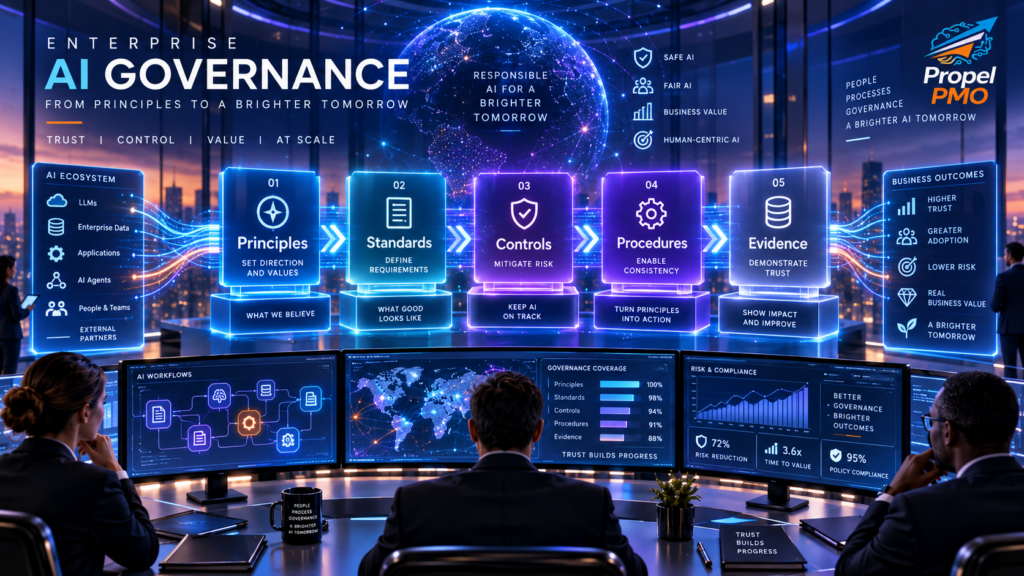
The Five Layers of an Enterprise AI Policy Stack
1. Enterprise AI Principles
This is the highest level. It defines the organization’s position on topics such as:
- Accountability
- Transparency
- Privacy
- Security
- Fairness
- Human oversight
- Responsible use
These principles establish direction. But principles alone do not govern execution.
2. AI Standards
Standards translate principles into enterprise expectations.
For example:
Principle: Protect sensitive information.
Standard: Restricted data cannot be submitted to unapproved external AI models.
Another example:
Principle: Maintain human accountability.
Standard: High-impact AI decisions must have a named human business owner.
Standards make policies measurable.
3. AI Control Requirements
This is where governance becomes operational. Controls may include:
- AI use-case approval
- Data classification review
- Security assessment
- Model validation
- Human approval requirements
- Agent authority limits
- Logging and traceability
- Performance monitoring
- Incident escalation
- Periodic review
Different AI solutions should receive different controls based on risk. A meeting-summary assistant should not require the same governance as an autonomous financial decision agent.
4. Delivery Procedures
Project and delivery teams need practical instructions.
For example:
Before an AI solution moves into production:
- Business owner identified
- AI risk classification completed
- Data sources approved
- Security review completed
- Testing completed
- Human oversight defined
- Monitoring established
- Incident process documented
- Production approval received
This is where the AI PMO becomes critical. The AI PMO ensures governance is embedded into delivery rather than added after development is complete.
5. Evidence and Audit
Every control should produce evidence. That may include:
- Approval records
- Risk assessments
- Test results
- Model documentation
- Access logs
- Agent activity logs
- Human override records
- Performance metrics
- Incident reports
Without evidence, governance becomes difficult to prove. Executives should be able to ask:
“Show me that this AI system meets our governance requirements.”
One Policy Does Not Fit Every AI System
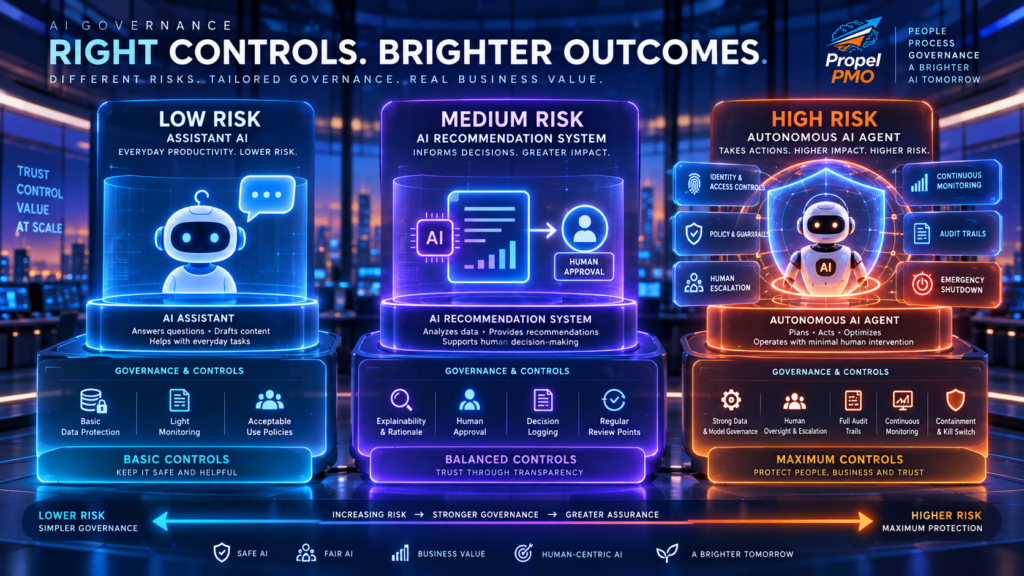
The most effective AI governance models are risk-based.
Consider three examples.
Low-Risk AI
An internal AI tool summarizes project meeting notes.
Governance may focus on:
- Data protection
- Approved tool usage
- Basic monitoring
Medium-Risk AI
An AI system recommends portfolio priorities.
Governance may require:
- Data validation
- Explainability
- Human approval
- Decision logging
- Periodic performance review
High-Risk AI
An autonomous agent executes customer-impacting or financial actions.
Governance may require:
- Formal risk approval
- Strict identity and access controls
- Defined autonomy limits
- Continuous monitoring
- Human escalation
- Detailed audit trails
- Emergency shutdown capability
Governance should increase with the potential impact of the AI system.
Where the AI PMO Fits
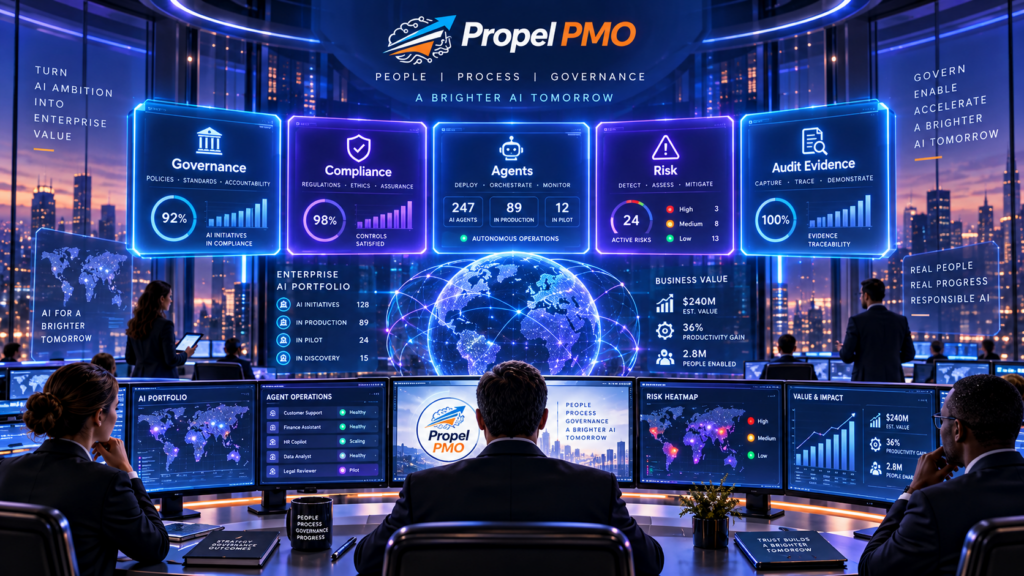
The AI PMO can serve as the coordination layer across the policy stack.
It connects:
Executive Leadership
Defines AI strategy and risk appetite.
Business Owners
Own AI outcomes and business decisions.
Technology Teams
Build and operate AI solutions.
Cybersecurity
Controls access and protects systems and data.
Risk & Compliance
Defines control requirements.
Legal & Privacy
Reviews regulatory and data obligations.
AI PMO
Coordinates governance across the AI portfolio.
This prevents each AI initiative from creating its own governance model.
Instead, teams operate within one enterprise framework.
From Policy Documents to Policy-as-Code
The next stage of AI governance will increasingly involve automating controls.
Instead of relying entirely on employees to remember policies, organizations can begin embedding rules directly into platforms and workflows.
Examples include:
- Automatically blocking restricted data from unauthorized AI models
- Preventing agents from exceeding transaction limits
- Requiring approval before high-risk actions
- Automatically logging agent decisions
- Triggering alerts when AI behavior crosses defined thresholds
This moves governance closer to policy-as-code.
The strongest control is often one that does not depend on someone remembering to follow it.
Final Thoughts
AI governance does not fail because organizations lack policies.
It often fails because policies never reach the systems, teams, and decisions they were intended to govern.
As enterprise AI scales, governance must move closer to execution.
The organizations that mature fastest will not simply publish responsible AI principles.
They will translate those principles into:
Standards.
Controls.
Workflows.
Evidence.
Accountability.
That is how responsible AI becomes operational. And that is where the AI PMO can create significant enterprise value.
About Propel PMO
Propel PMO helps organizations establish AI PMOs, governance frameworks, portfolio management practices, and enterprise delivery models that support responsible AI adoption and measurable business value.
Govern Smarter. Deliver Faster. Scale Confidently.
By Kinjal Shah & Dhruvak Shah