
By the early 2030s, the enterprise organization chart may no longer show only people.
It may show two numbers:
- Human workforce
- AI workforce
A finance team may include analysts, controllers, and AI agents supporting forecasting, reconciliation, and reporting. A PMO may include program managers, business analysts, and AI agents supporting scheduling, risk monitoring, documentation, and portfolio reporting. The future workforce will not be measured only by headcount. It will be measured by total enterprise capacity.
The question may shift from:
How many people do we have?
To:
How much work can our combined human and AI workforce perform responsibly?
That shift is already beginning.
From AI Assistants to AI Workers
Today, most organizations use AI to:
- Draft content
- Summarize meetings
- Analyze data
- Support customer service
- Assist developers
The next stage is different.
AI agents will increasingly be able to:
- Plan work
- Execute routine tasks
- Monitor risks
- Update systems
- Escalate exceptions
- Coordinate with other agents
That moves AI from assistance to execution. And once AI begins executing work, governance becomes essential.
AI Agents Will Need Real Identities
Today, many AI tools are treated like software integrations. That may not be enough in the future.
Every enterprise AI agent should eventually have:
- A unique identity
- A defined business role
- A named owner
- Approved access
- Authority limits
- An audit trail
- A review date
- A retirement date
Executives will need to answer:
Which AI agent made this decision, under whose authority, and using which data?
Autonomy Will Be Tiered
Not every AI agent should have the same authority. A practical enterprise model may look like this:
Tier 1: AI-Assisted
The agent drafts or recommends. A human approves the action.
Tier 2: Controlled Execution
The agent acts within defined limits. Humans review exceptions.
Tier 3: Autonomous Execution
The agent operates independently in a controlled environment. Humans monitor performance and audit results.
The key point is simple. AI autonomy should be earned, not assumed. Agents should move between tiers based on performance, risk, accuracy, and business impact.
AI-to-AI Work Will Create New Risks
Future AI agents will not only work with people. They may work with other AI agents.
For example:
- A procurement agent negotiates with a supplier’s sales agent.
- A project scheduling agent coordinates with a resource planning agent.
- A compliance agent reviews the decision of a financial agent.
This raises new questions:
- Can one agent delegate to another?
- Who owns the final decision?
- What happens when agents disagree?
- Who is accountable if both agents make the wrong call?
Governance frameworks focused only on human-AI interaction may not be enough.
Workforce Planning Will Include Compute
Human workforce planning is tied to:
- Salaries
- Benefits
- Contractors
- Facilities
- Equipment
AI workforce planning will be tied to:
- Model usage
- Cloud infrastructure
- API costs
- Data storage
- Monitoring
- Licensing
- Security
Adding ten AI business analysts may sound like a staffing decision. In reality, it may also be a compute and infrastructure decision. Workforce planning and technology budgeting will increasingly overlap.
The Work Does Not Disappear — It Changes
The future of work is often described as humans versus AI. That is too simple.
AI will likely handle more:
- Repetitive analysis
- Monitoring
- Documentation
- Pattern recognition
- Routine workflow execution
Humans will remain essential for:
- Judgment
- Leadership
- Accountability
- Relationships
- Strategy
- Ethical decisions
- Handling uncertainty
The strongest organizations will not choose between humans and AI. They will design work so both are used where they create the most value.
What Leaders Manage Today vs. Tomorrow
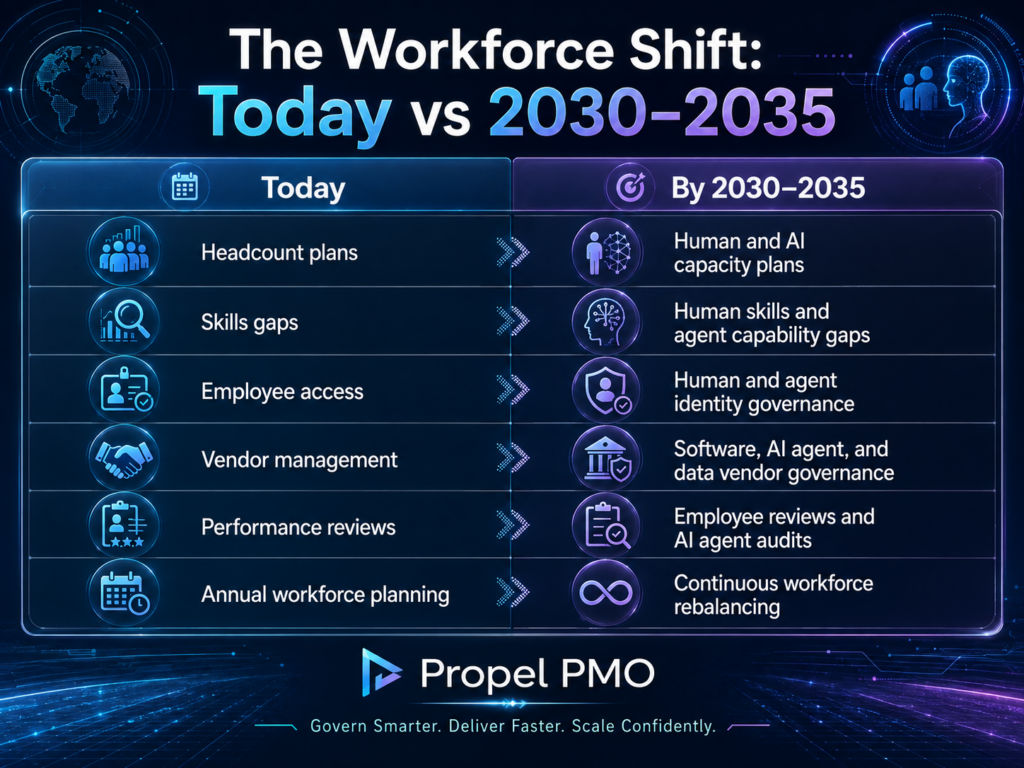
The management challenge becomes broader. Leaders will need to manage people, agents, vendors, models, compute, and risk as one operating system.
Five Capabilities Every Enterprise Will Need
1. Work Classification
Organizations should continuously decide which work is:
- Human-led
- AI-assisted
- AI-executed with review
- Fully autonomous
- Not suitable for AI
2. Clear Agent Roles
Every AI agent should have a documented purpose, owner, authority, and escalation path.
3. Measurable Performance
AI agents should be measured using metrics such as:
- Accuracy
- Cost per task
- Productivity impact
- Exception rate
- Compliance
- Human override rate
4. Named Human Accountability
Every production AI agent should have a human owner. AI can execute work. It cannot absorb organizational accountability.
5. Continuous Optimization
The right balance of people and AI will change quickly. Organizations will need to review workforce design continuously, not once a year.
The AI PMO Becomes the Control Tower
The AI PMO can become the function that coordinates this new environment.
A mature AI PMO may oversee:
- AI portfolio governance
- AI use-case prioritization
- Agent lifecycle management
- AI risk and compliance
- Workforce capacity planning
- Executive reporting
- Compute cost oversight
- Benefit realization
- AI vendor governance
The AI PMO does not replace the traditional PMO. It expands it. Its role is to connect innovation, execution, risk, and accountability.
Questions Leaders Should Ask Now
Organizations do not need to wait until 2030. They can begin preparing today.
Leadership teams should ask:
- Which decisions must remain human-led?
- Which AI agents are already operating in production?
- Who owns each one?
- How is agent performance measured?
- Can every AI action be audited?
- Are we deploying AI faster than we can govern it?
These questions reveal whether an organization is building sustainable AI capability or simply adding more tools.
Final Thoughts
The workforce of 2030 may not be defined by how much work AI performs. It may be defined by how well that work is governed.
The future enterprise will combine:
- Human judgment
- AI execution
- Clear accountability
- Continuous oversight
The organizations that succeed will not necessarily have the most AI agents.
They will be the ones who can answer four questions for every agent in production:
Who owns it?
What is it allowed to do?
How is it measured?
What happens when it is wrong?
That is where the AI PMO becomes essential.
Key Takeaways
✔ Workforce planning will include both people and AI agents.
✔ AI agents will need identities, owners, permissions, and audit trails.
✔ Autonomy should be tiered and earned.
✔ AI-to-AI work will require new governance controls.
✔ Compute and model costs will become part of workforce planning.
✔ The AI PMO can become the control tower for responsible AI execution.
About Propel PMO
Propel PMO helps organizations establish AI PMOs, governance frameworks, portfolio management practices, and enterprise delivery models that support responsible AI adoption and measurable business value.
Govern Smarter. Deliver Faster. Scale Confidently.
By Dhruvak Shah – with support from Propel PMO Team