
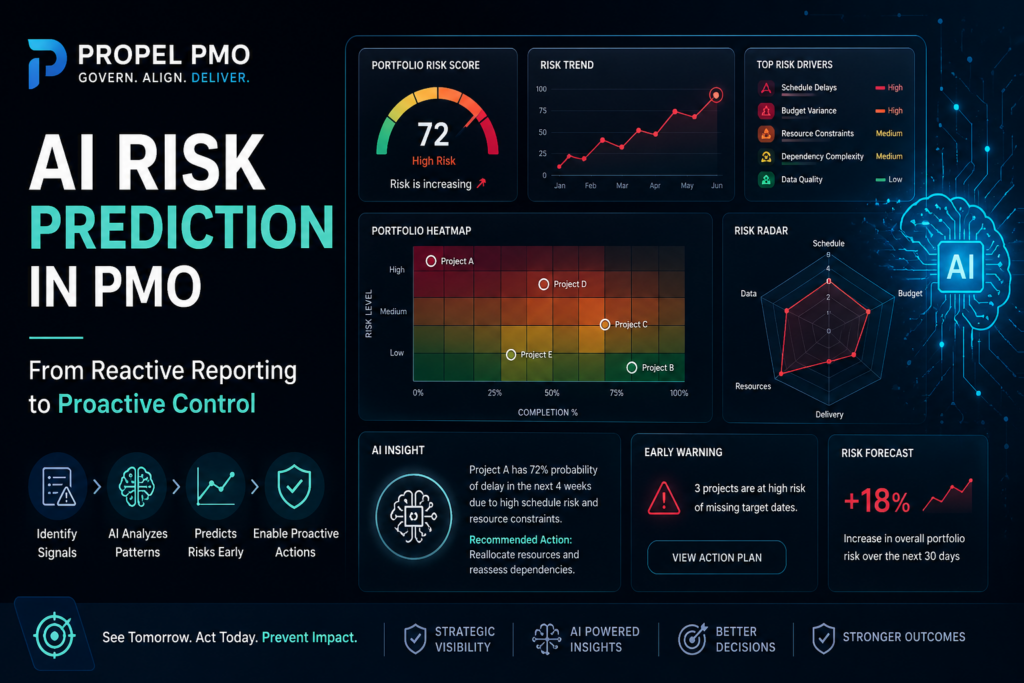
AI-driven risk prediction score
The Problem with Traditional Risk Management
Most PMOs today are still operating in a reactive mode.
- Risks are logged manually
- Updates depend on project managers
- Escalations happen after impact
- Leadership sees problems too late
By the time a project turns red, the damage is already done.
What’s Changing with AI
AI is shifting PMOs from:
- Tracking risks
- Reporting risks
- Explaining risks
To:
👉 Predicting risks before they happen
What AI Risk Prediction Actually Means
AI Risk Prediction is not magic.
It uses patterns already present in your portfolio data:
- Delays in completion %
- High dependency chains
- Repeated schedule slips
- Budget variance trends
- Low priority or weak performance signals
These signals already exist — AI simply connects them faster and more accurately.
What Your Portfolio Data Is Already Telling You
In a typical PMO dashboard:
A project showing:
- Low completion progress
- High delivery and budget risk
- Weak performance indicators
👉 This is not just “High Risk”
👉 This is a likely future failure
AI enables teams to identify this weeks earlier, not at escalation.
From Risk Logs to Risk Intelligence
Traditional PMO:
- Risk registers and spreadsheets
- Weekly updates
- Subjective scoring
AI-enabled PMO:
- Continuous risk monitoring
- Pattern recognition
- Early warning signals
- Prioritized action recommendations
What an AI Risk Prediction Engine Looks Like
You don’t need complex systems to get started.
A practical approach includes:
- Using existing project and portfolio data
- Applying structured scoring models
- Leveraging AI for interpretation and insights
Example outputs:
- “Project A has a high probability of delay in the next 4 weeks”
- “Portfolio risk is increasing due to dependency clusters”
- “Reallocate resources to reduce overall delivery risk”
Why This Matters for Leadership
Executives don’t need more reports.
They need clarity:
👉 What is going to fail?
👉 What should we do now?
AI Risk Prediction answers both.
Where Most PMOs Go Wrong
Common mistakes include:
- Trying to replace project managers with AI
- Overengineering solutions too early
- Focusing on tools instead of decisions
Instead, start with:
- The data you already have
- The patterns you already see
- The decisions you already make
The Propel PMO Approach
At Propel PMO, the focus is on:
- Embedding risk prediction into daily delivery workflows
- Connecting portfolio data to decision-making
- Enabling early intervention instead of late escalation
Because governance should not just report risk —
it should prevent failure
Final Thought
AI will not replace PMOs.
But PMOs that use AI will replace those that don’t.
By Dhruvak Shah