
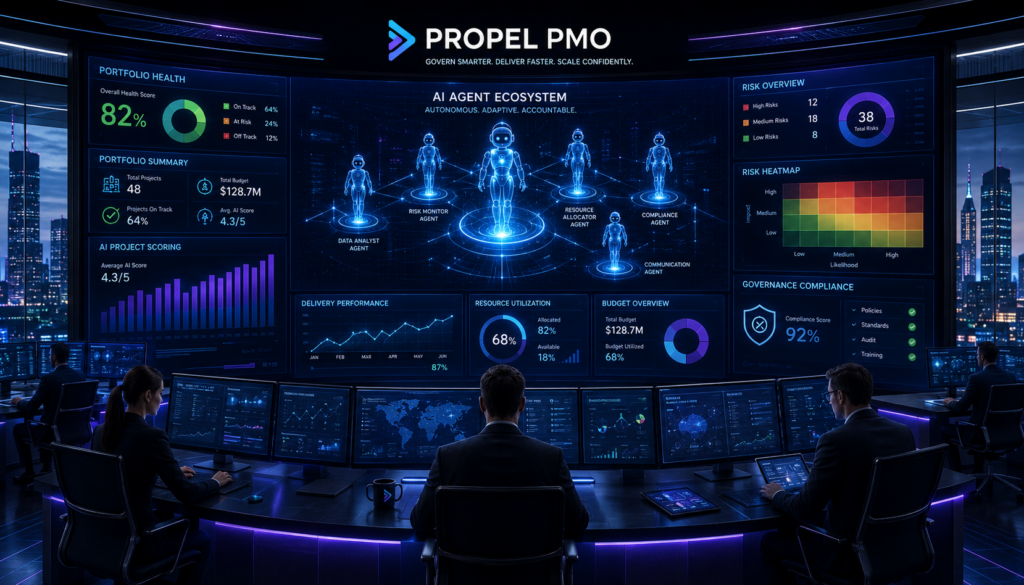
Introduction
The enterprise AI conversation is moving fast.
Organizations are no longer only experimenting with chatbots, copilots, and productivity assistants. They are entering a new phase of Agentic AI — intelligent systems that can plan, reason, make decisions, and execute multi-step work with limited human intervention. This shift creates a powerful opportunity.
AI agents can accelerate operations, reduce manual effort, improve decision cycles, and unlock new levels of enterprise productivity. But they also introduce a new class of risk: autonomous decisions, unclear ownership, hidden compliance exposure, data access concerns, and limited auditability. The reality is simple:
Scaling AI without governance is not innovation. It is unmanaged risk.
As organizations move from AI experimentation to AI execution, governance can no longer be an afterthought. It must become part of the operating model.
What is Agentic AI?
Traditional AI systems typically respond to prompts, summarize information, generate content, or assist users with specific tasks. Agentic AI goes further.
Agentic AI systems can:
- Plan tasks autonomously
- Execute multi-step workflows
- Access enterprise applications
- Interact with APIs, databases, and business systems
- Make recommendations and decisions
- Coordinate with other AI agents
- Trigger actions across operational processes
Common enterprise examples include:
- IT Service Desk Agents
- Financial Analysis Agents
- Procurement Agents
- Customer Service Agents
- HR Onboarding Agents
- Compliance Review Agents
- Project Management Agents
The shift is clear: AI is moving from assistance to execution.
That shift changes everything. When AI only recommends, the risk is limited. When AI begins to act, approve, route, escalate, update, trigger, or decide, the enterprise needs stronger controls.
The Governance Gap
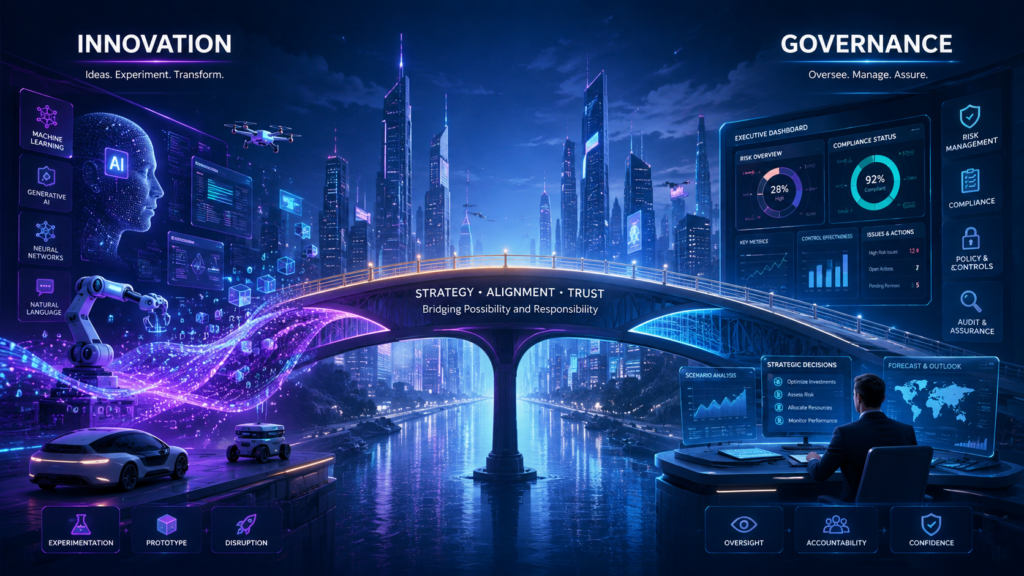
Most organizations already have governance models for traditional technology functions.
They govern:
- Software development
- Cybersecurity
- Data management
- Cloud platforms
- Vendor management
- Regulatory compliance
- Project and portfolio delivery
But AI agents create a different governance challenge.
They do not always behave like traditional software. They may adapt, learn from context, make probabilistic decisions, interact with multiple systems, and execute actions faster than human teams can review them manually.
This creates critical questions:
- Who owns AI-driven decisions?
- Who approves AI actions before they occur?
- What level of autonomy is acceptable?
- How are errors detected and corrected?
- How are compliance requirements enforced?
- How are AI actions documented and audited?
- Who is accountable when an AI agent creates business impact?
Without clear answers, organizations risk losing visibility, control, and trust. The governance gap is not only a technical issue. It is an enterprise operating model issue.
AI Risk Landscape
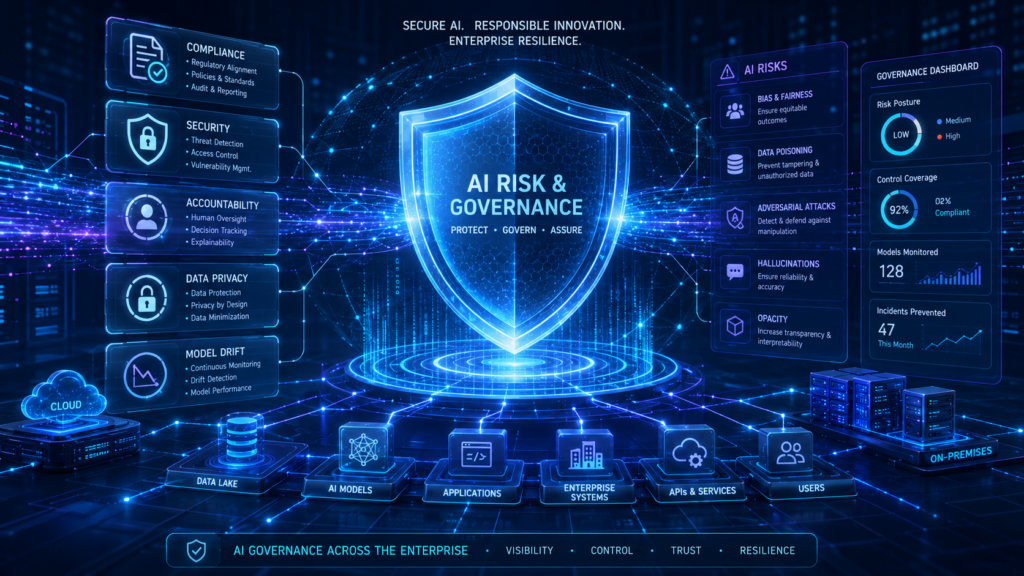
Agentic AI introduces risks that traditional governance models may not fully address.
1. Autonomous Decision Risk
AI agents can execute hundreds or thousands of actions in a short period of time. A flawed rule, poor data input, weak control, or incorrect model output can quickly scale into a major operational issue. The faster AI acts, the faster risk can spread.
2. Data Exposure Risk
Many AI agents require access to sensitive enterprise data, internal systems, customer records, contracts, financial information, or employee data.
Without proper access controls, data classification, and monitoring, organizations may expose information beyond its intended use.
3. Compliance Risk
Regulators, auditors, customers, and internal stakeholders are increasingly focused on AI transparency, explainability, fairness, privacy, and accountability.
Organizations must be able to demonstrate how AI decisions are made, controlled, reviewed, and corrected.
4. Accountability Risk
When humans make decisions, ownership is usually clear. When AI systems recommend, decide, or act independently, accountability becomes more complex.
Enterprises must define who is responsible for the AI agent, the process it supports, the data it uses, the controls around it, and the outcomes it creates.
5. Model Drift Risk
AI performance can degrade over time as business conditions, data patterns, user behavior, regulations, and operating environments change.
Without continuous monitoring, an AI system that performs well today may create risk tomorrow.
6. Operational Control Risk
AI agents may interact with multiple platforms, workflows, and business functions. Without centralized oversight, organizations may lose visibility into where agents are deployed, what they are doing, and how much authority they have.
This is where governance becomes essential.
Building an Agentic AI Governance Framework
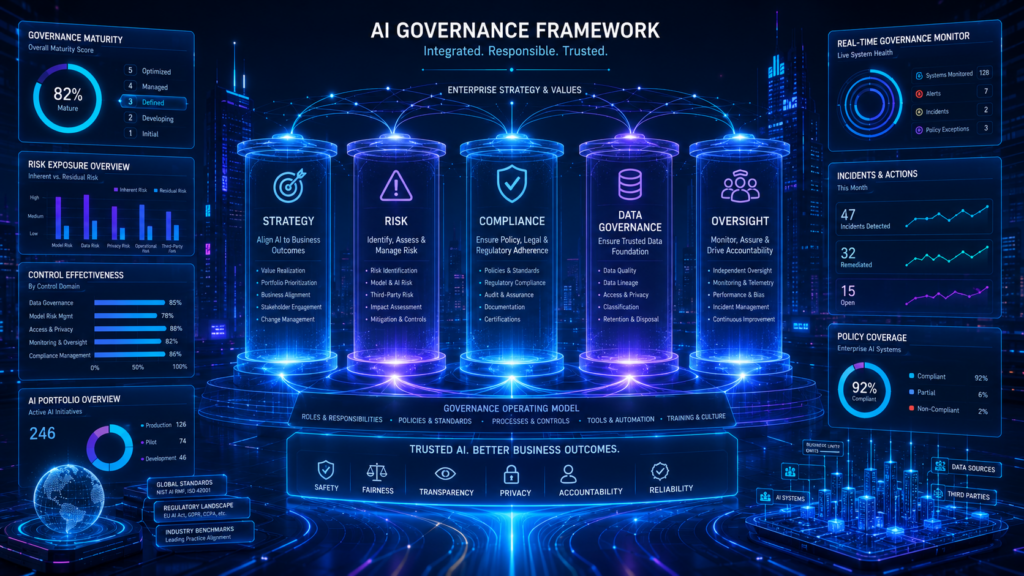
Organizations cannot govern Agentic AI with ad hoc controls or isolated policies.
They need a structured framework that connects strategy, ownership, risk, compliance, monitoring, and execution. A strong Agentic AI Governance Framework should include five core pillars.
1. Strategy and Use Case Governance
Not every process should be automated.
Before deploying AI agents, organizations should evaluate the business value, complexity, risk level, data sensitivity, regulatory exposure, and operational impact of each use case.
The goal is not to deploy AI everywhere. The goal is to deploy AI where it creates measurable value and can be governed responsibly.
Key questions include:
- What business problem does the AI agent solve?
- What value is expected?
- What process will it impact?
- What systems will it access?
- What risks could it create?
- What level of autonomy is appropriate?
Strong governance begins before the AI agent goes live.
2. Roles and Accountability
Every AI initiative needs clear ownership.
Organizations should define who is accountable for the AI use case, business outcome, data quality, technical performance, risk controls, compliance oversight, and ongoing monitoring.
At minimum, each AI initiative should have:
- Business owner
- Technology owner
- Risk or compliance owner
- Data owner
- Executive sponsor
- Operational support owner
Accountability cannot be vague. When AI systems act on behalf of the enterprise, ownership must be explicit.
3. Human-in-the-Loop Controls
Not every AI action should be fully autonomous. Critical decisions should include human oversight, approval checkpoints, escalation paths, and exception handling.
Human-in-the-loop controls are especially important when AI impacts:
- Customers
- Financial decisions
- Regulatory obligations
- Employee outcomes
- Legal or compliance processes
- Security-sensitive workflows
- High-risk operational decisions
The right governance model does not slow innovation. It defines where human judgment is required and where automation can safely scale.
4. Monitoring and Performance Management
AI governance does not end at deployment.
Organizations must continuously monitor AI performance, accuracy, exceptions, usage, risk indicators, business outcomes, and control effectiveness.
Monitoring should include:
- Model performance
- Decision quality
- Bias and fairness indicators
- Data quality
- Access and usage patterns
- Exceptions and overrides
- Business impact
- Compliance metrics
- Drift detection
This creates the visibility executives need to understand whether AI is delivering value safely.
5. Audit and Traceability
Every AI action should be explainable, documented, and auditable.
Organizations need the ability to answer:
- What did the AI agent do?
- Why did it make that recommendation or action?
- What data did it use?
- Who approved it?
- What systems were impacted?
- What exception occurred?
- What corrective action was taken?
Auditability is not optional for enterprise AI. It is the foundation for trust.
The Emerging Role of the AI PMO
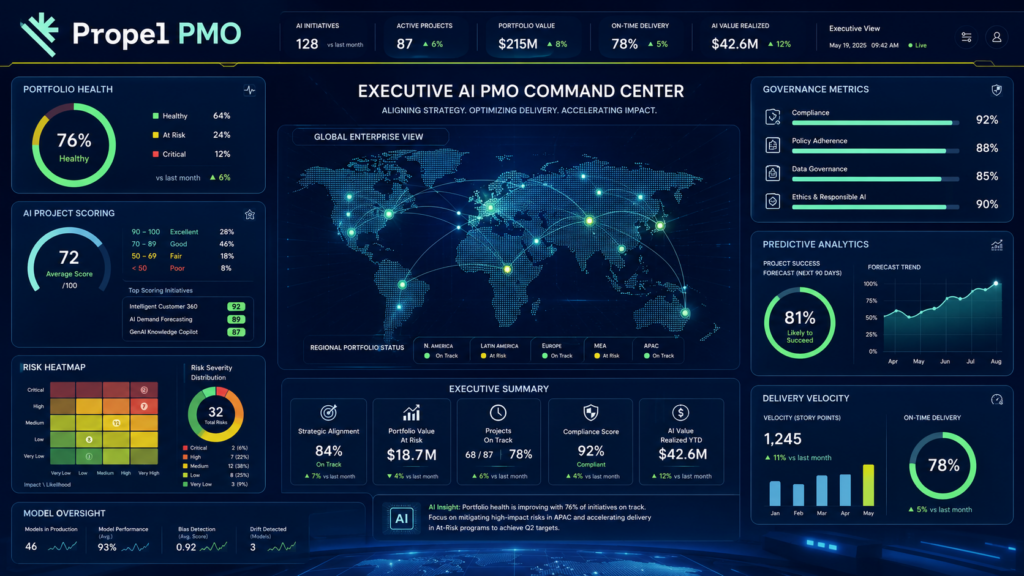
Traditional PMOs were primarily designed to govern projects, programs, timelines, budgets, dependencies, and delivery outcomes. Agentic AI requires a broader governance structure.
AI initiatives are not only technology projects. They involve business process redesign, data governance, risk management, regulatory oversight, adoption, change management, and continuous performance monitoring.
This is where the AI PMO becomes critical. An AI PMO provides the operating layer that connects AI innovation with enterprise control.
It supports:
- AI portfolio governance
- AI use case prioritization
- AI risk management
- Compliance oversight
- Delivery governance
- Executive reporting
- Adoption measurement
- Benefits realization
- Model and agent monitoring
- Cross-functional accountability
The AI PMO helps organizations answer three important executive questions:
Are we investing in the right AI initiatives?
Are we delivering measurable business value?
Are we scaling AI safely and responsibly?
This is the next evolution of enterprise governance. The AI PMO is not just a reporting function. It is the control center for responsible AI execution.
Why This Matters Now
Agentic AI will transform how enterprises operate. It will change how work is assigned, how decisions are made, how services are delivered, how risks are monitored, and how teams interact with technology.
But the organizations that win with AI will not simply be the ones that deploy the most agents. They will be the organizations that can govern intelligent systems with discipline, transparency, and confidence.
AI without governance creates risk. AI with governance creates scalable enterprise value.
Conclusion
Agentic AI represents one of the most important shifts in enterprise technology. It moves AI from passive support to active execution. That shift requires a new level of governance.
Organizations must define ownership, establish controls, monitor performance, enforce compliance, and create auditability across the full AI lifecycle.
The future of AI will not be determined only by model performance. It will be determined by how effectively organizations govern intelligent systems operating at enterprise scale.
The next generation of enterprise AI will require more than innovation. It will require structure, accountability, and trust.
Key Takeaways
✅ AI agents are moving from assistants to autonomous execution systems.
✅ Governance must evolve beyond traditional project and technology controls.
✅ Organizations need clear accountability, monitoring, compliance, and auditability.
✅ Human oversight remains essential for high-risk decisions and enterprise-critical workflows.
✅ AI PMOs are emerging as critical governance structures for scaling AI responsibly.
✅ Enterprises that govern AI effectively will scale faster, reduce risk, and create stronger business value.
Final Thought
The next wave of AI will not be about who experiments the fastest. It will be about who scales the smartest.
Govern Responsibly. Scale Confidently. Deliver Value.
By Dhruvak Shah
With editorial support from the Propel PMO team
Great perspective on Agentic AI. As organizations move from AI assistance to AI execution, governance becomes essential — not optional. The real differentiator will be how well enterprises define accountability, monitor risk, and scale AI responsibly.
Great perspective on Agentic AI governance. As AI agents move from simple assistance to real execution, enterprises need stronger accountability, monitoring, auditability, and human oversight. Scaling AI without governance can create serious operational and compliance risk, but with the right AI PMO structure, organizations can scale responsibly and deliver real business value.