
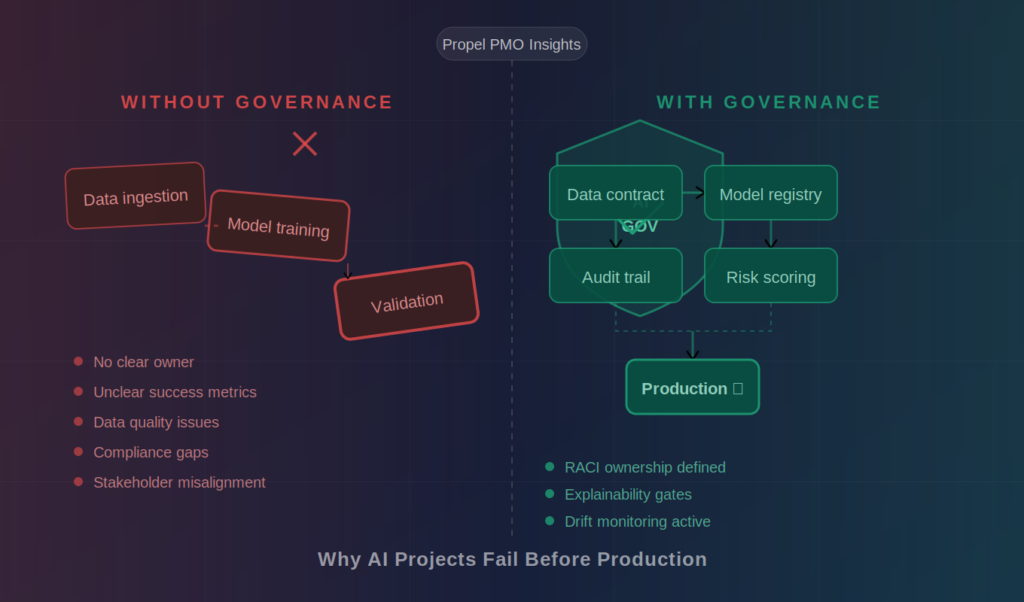
Why AI Projects Fail Before Production
Organizations worldwide are pouring hundreds of billions into AI. IDC reported that AI infrastructure spending alone reached $89.9 billion in Q4 2025 and $318 billion for full-year 2025, while Stanford’s 2025 AI Index reported $252.3 billion in corporate AI investment in 2024.
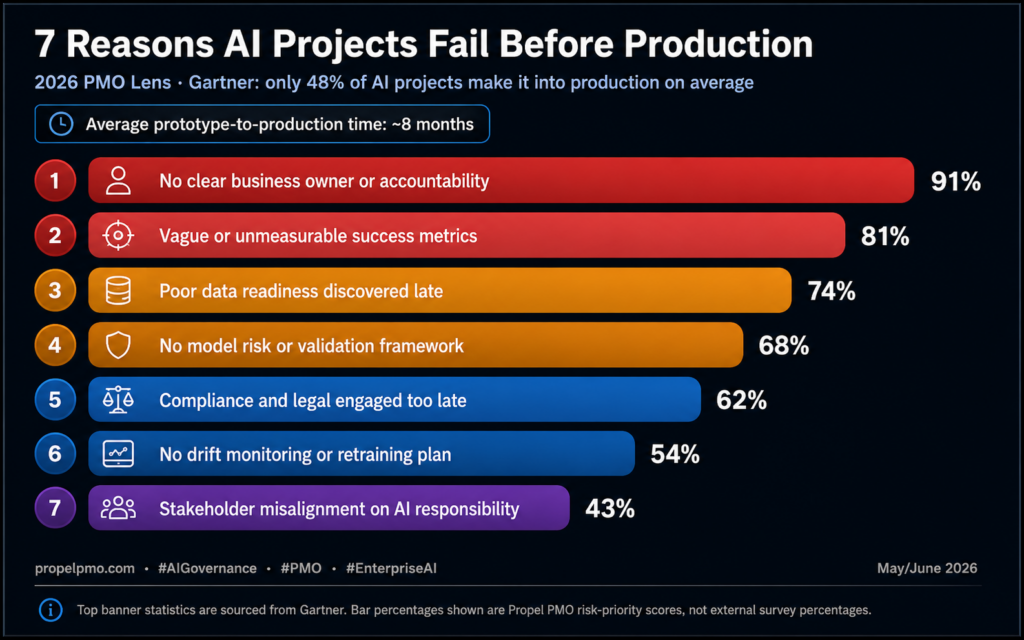
Yet many AI initiatives still struggle to move beyond pilots. Gartner has reported that, on average, only 48% of AI projects make it into production, and that it takes about 8 months to move from prototype to production. Gartner has also warned that through 2026, organizations may abandon many AI projects that are unsupported by AI-ready data.
The culprit is not always the technology. The models may work. The data science teams may be talented. The executive appetite may be real.
The failure is often organizational — unclear ownership, weak governance, poor data readiness, compliance gaps, and no operating model to move AI from pilot to production.
And that is fixable.
Why AI Is Not Like Any Other IT Project
Most organizations approach AI the way they approached ERP implementations in the 2000s: define requirements, build the thing, deploy it, move on. That mental model is why they fail.
AI systems are probabilistic, not deterministic. They drift. They reflect the biases baked into training data. They produce different outputs on different days. And when something goes wrong — a regulatory audit, a biased outcome, a model hallucination that reaches a customer — nobody can point to who owned the decision to deploy.
AI without governance is an uninsured asset behind the wheel of your business.
The 7 Failure Modes (And What They Really Mean)
1. No Clear Business Owner AI projects born in IT never survive contact with the business. Without a named executive accountable for outcomes — not just delivery — projects drift until budget runs out.
2. Vague Success Metrics “Improve efficiency” is not a success metric. If you can’t measure it before and after, you can’t defend the investment, and you can’t course-correct when the model underperforms.
3. Data Quality Treated as a Later Problem It isn’t. Garbage in, garbage out is still the law. Data contracts, lineage tracking, and quality gates need to exist before the first model is trained — not discovered in production.
4. No Model Risk Framework Financial services figured this out a decade ago with SR 11-7. Every other industry is catching up the hard way. Without model validation, stress testing, and a defined risk tier, you’re flying blind.
5. Compliance Brought In at the End Legal and compliance teams who see an AI deployment for the first time two weeks before launch will stop it. Every time. Governance means they’re in the room from day one.
6. No Drift Monitoring Plan A model that performs well in January may degrade by July as the world changes. Most organizations have no plan to detect this until a failure surfaces publicly.
7. Stakeholder Misalignment on “AI Responsibility” When the model makes a bad call — and eventually it will — who is responsible? If the answer isn’t documented in a RACI before launch, the answer becomes “nobody” and “everybody” simultaneously.
What AI Governance Actually Looks Like in Practice
Governance isn’t a bureaucracy layer. Done right, it’s a velocity enabler — because teams stop rebuilding trust from scratch on every project.
Here’s what a mature AI governance framework covers:
→ AI Inventory & Classification Every model, every use case, every risk tier — catalogued. You can’t govern what you can’t see.
→ Model Risk Tiering Not every model carries equal risk. A customer-facing credit decision model is Tier 1. An internal scheduling assistant is Tier 3. Tiering determines the rigor of validation required.
→ Data Governance Integration AI governance and data governance are not separate programs. They’re the same program at different layers. Data lineage, access controls, and quality SLAs feed directly into model reliability.
→ Explainability Gates Before any model touches a regulated use case or customer outcome, there must be a documented answer to: “Can we explain this decision to a regulator, a customer, or a court?”
→ Continuous Monitoring & Retraining Triggers Define drift thresholds. Define who gets alerted. Define what triggers a model pause vs. a retrain vs. a full rollback.
→ RACI for AI Accountability Data scientist. ML engineer. Business owner. Risk officer. Legal. Each role has a defined accountability — not just during build, but in perpetuity while the model is live.

The PMO’s Role in AI Governance
This is where most organizations have a structural gap.
The PMO is uniquely positioned to operationalize AI governance — not because program managers are data scientists, but because they own the connective tissue: the intake process, the stage gates, the stakeholder alignment, the risk registers, and the portfolio view.
An AI-enabled PMO doesn’t just track projects. It governs AI as a portfolio asset.
At Propel PMO, we’ve operationalized this through:
- AI intake forms with built-in risk classification
- Stage gates that require governance artifacts before model deployment
- A living AI project registry (now powered by Claude via our Streamlit dashboard)
- Compliance checklists mapped to emerging regulations including the EU AI Act
The Governance Dividend: What Changes When You Get This Right
Organizations with mature AI governance see:
✦ Faster time to production — because compliance and risk are resolved incrementally, not as a launch-blocking sprint
✦ Higher confidence in model outputs — because validation is systematic, not heroic
✦ Lower rework costs — because failure modes are caught at gates, not in production
✦ Audit-readiness — because documentation exists before anyone asks for it
✦ Reusable infrastructure — because the second AI project inherits the guardrails the first one built
What to Do Going Forward
If your organization is running AI initiatives without a governance framework, here’s where to start:
- Audit your current AI inventory. What models are in use? Who owns them? Are they monitored?
- Define your risk tiers. Not all AI needs the same rigor. Tiering lets you move fast where it’s safe and slow where it matters.
- Bring PMO into AI project intake. Governance can’t be retrofitted — it must be baked into how projects start.
- Align with emerging regulation now. The EU AI Act, NIST AI RMF, and sector-specific guidance are shaping requirements. Early movers will have an advantage.
- Build your model registry. Even a spreadsheet is better than nothing. A structured registry in your PMO dashboard is better still.
Final Thought
The organizations winning with AI right now aren’t the ones with the biggest budgets or the most sophisticated models. They’re the ones that treat AI as a governed enterprise asset — with accountability, traceability, and a plan for when things go wrong.
Governance doesn’t slow AI down. It’s what gets AI across the finish line.
Kinjal Shah is an IT Program Director and PMO strategist with 15+ years in financial services and enterprise technology. He leads Propel PMO and The Agile Partners, helping organizations operationalize AI governance, delivery frameworks, and custom software development.
Connect on LinkedIn | Visit propelpmo.com | Book a governance readiness assessment